
FREE TOOL · NO SIGNUP · PRIVATE & SIMPLE · DESIGNED FOR MEN
Male Body Type Calculator:
Discover Your Body Shape Using Measurements
This male body type calculator is built for men and uses four measurements: chest, waist, hips and shoulder width. It sorts you into one of five shapes (trapezoid, rectangle, oval, triangle or inverted triangle) and shows your waist-to-hip ratio next to the result. Below the tool we show the exact rule behind each shape, so you can check your result with a tape measure and a calculator instead of taking our word for it.
Find your exact male body shape
Three measurements in. One clear result out.
Sample proportions
One thing we’ll say up front. For women’s body shapes there’s published research behind the categories. For men, we haven’t found a comparable research framework, so the rules on this page are our own. We explain them in full and point out where they’re judgment calls.
If you’d rather start with a broader overview, our body shape calculator covers men and women, and there’s a separate female body type calculator for women.
Body Type Calculator For Men
Hey boys find your perfect body shape in minutes
Enter your chest, waist, hip, and shoulder measurements to discover your male body shape. Get instant results privately, with calculations performed directly in your browser.
Let's start with the basics
This helps us use the right measurement guide and result categories.
Upper body measurement
Measure at the fullest point, keeping the tape level and snug (not tight).
Waist measurement
Find your natural waist — usually the narrowest point above your belly button.
Hip measurement
Measure around the fullest part of your hips/seat.
—
—
Shoulders/Bust · Waist · Hips — plotted to scale
Methodology
How the Male Body Shape Calculator Sorts You Into 5 Shapes
The calculator compares three circumferences: chest, waist and hips. Every rule is a ratio, such as hips divided by chest, so the units don’t matter. Inches and centimeters give the same shape.
Five shapes are checked in a fixed order: oval first, then triangle, inverted triangle and trapezoid. Rectangle comes last and catches everything that doesn’t match the others. The first rule your numbers satisfy decides the result. Order matters because one set of measurements can fit more than one description, and checking oval first means a body whose waist is the widest point is never mislabeled as something else.
The order the rules are checked · first match wins
1 · Oval → 2 · Triangle → 3 · Inverted triangle → 4 · Trapezoid →
5 · Rectangle (everything else)
Our cutoffs are judgment calls, not figures from a study. We chose them so each shape lines up with how it’s normally described, for example a trapezoid as a chest somewhat wider than the hips with a clear drop to the waist. A body that sits a few percent either side of a cutoff will land between two shapes.
When that happens, the calculator tells you. If a deciding ratio is within 2 percentage points of a cutoff, you’ll see the neighboring shape as a “close to” result next to your main one. That isn’t indecision. It’s an honest report that your numbers sit near a line.
Two Different Measurements
Shoulder Width vs. Chest:
Why the Calculator Asks for Both
They’re two different measurements, and only one of them decides your shape.
Two Different Measurements
Chest
The distance around your torso at its fullest point. It’s a circumference, like your waist and hips, so the rules can compare the three directly. That’s why chest drives the result.
Shown for fit
Shoulder width
A straight line across your back from the edge of one shoulder to the edge of the other. It isn’t a circumference, so dividing it by your hips or waist wouldn’t tell you anything meaningful, and it doesn’t change your shape.
We still ask for shoulder width because shirt and jacket fit depends heavily on it, and because it lets you see upper-body changes over time even when your chest number barely moves. Whichever method you pick, use the same one every time you remeasure. Switching methods between visits can make it look like your body changed when only the way you measured did.
The Rules, In Full
The 5 Male Body Shapes and Their Measurement Rules
In the rules below, C is chest, W is waist and H is hips. They’re checked top to bottom, and the first match wins.
Shape
Explanation
Our rule
Oval
Waist is the widest measurement
W is at least as large as both C and H
Triangle
Hips clearly wider than chest
H ≥ 1.05 × C
Inverted Triangle
Chest clearly wider than hips
C ≥ 1.10 × H
Trapezoid
Chest somewhat wider than hips, with a clear drop to the waist
C ≥ 1.03 × H (and under 1.10 × H), and W ≤ 0.90 × C
Rectangle
Chest and hips close, or little drop to the waist
Everything else
A multiplier like 1.05 means 5% bigger. With hips of 40 inches, for example, a triangle needs a chest of 38.1 inches or less, and an inverted triangle needs a chest of 44 inches or more.
Shoulder width
Both have a chest that leads the hips. The size of the lead is what separates them. In a trapezoid the chest is 3% to 10% wider than the hips and the waist is at least 10% smaller than the chest. In an inverted triangle the chest is 10% or more wider than the hips.
Does this sound like you?
Rectangle and Oval
A rectangle has chest, waist and hips in a fairly narrow range, or a chest that leads slightly without much drop to the waist. An oval is the one shape where the waist is the largest measurement, so the midsection sets your size.
Does this sound like you?
Triangle
A triangle has hips at least 5% wider than the chest. It’s less common as a male result than the other four, but it’s a real and distinct pattern.
Does this sound like you?
Transparency
Same Chest, Waist and Hips, Different Result:
A Worked Example
Chest 42″ · Waist 34″ · Hips 38″
Here’s how the rules above play out, in order:
- Oval needs the waist to be the widest measurement. 34″ is smaller than both 42″ and 38″, so no.
- Triangle needs hips of at least 1.05 × chest, which is 44.1″. Hips are 38″, so no.
- Inverted triangle needs a chest of at least 1.10 × hips, which is 41.8″. A chest of 42″ clears it, so this is the result.
Chest ÷ hips is 1.105, only just above the 1.10 cutoff, so the calculator also shows trapezoid as a “close to” result.
Now take one inch off the chest:
Chest | Chest ÷ hips | Waist ÷ chest | Inverted triangle (close to trapezoid) |
42″ | 1.105 | 0.81 | 0.81 |
41″ | 1.079 | 0.83 | Trapezoid |
At 41″ the chest falls under 41.8″, so inverted triangle no longer applies. Trapezoid needs a chest of at least 1.03 × hips (39.1″) and a waist no more than 90% of the chest (36.9″), and 41″ and 34″ both qualify.
Same hips, same waist, and one inch of chest changes the label. That’s why the measuring advice above matters, and why a result near a cutoff comes with a “close to” shape instead of false certainty.
A Common Search
Broad Shoulders in Men: What They Do and Don’t Tell You
“Broad shoulders” is one of the most-searched phrases around men’s proportions, so it’s worth being clear about what it does and doesn’t mean here.
In everyday use it’s an impression, and the impression comes from shoulder width compared with the rest of the body, not from the shoulder number alone. A man with wide shoulders and an equally wide waist and hips reads as solidly built, and his numbers will often land on rectangle. A man with average shoulders and narrow hips can look broad-shouldered because of the contrast, and his chest and hips may land on trapezoid or inverted triangle.
In this calculator, chest decides the shape and shoulder width doesn’t change it. Your shoulder number is more useful for fit. If a jacket fits across your chest but pinches at the shoulder seams, or the shoulders fit and the body billows, shoulder width is part of the reason.
It’s also worth knowing what can change. The bones that set your shoulder width stop growing in adulthood, while the muscle around them can change how broad you look and can change your chest measurement. So if your shape result moves over time, it’s usually your chest or waist that moved, not your frame.
A Different Tool Entirely
Male Body Type Calculator With Height and Weight: Why Muscle Breaks BMI
Some calculators ask for height and weight instead of a tape measure. That combination gives you BMI, which is weight divided by height squared. It has no idea where your weight sits, and it can’t tell muscle from fat, so a muscular man and a man carrying more fat can post the same number at the same height and weight.
That’s why this calculator doesn’t use height or weight. Two men with the same BMI can land on different shapes, and a site that returns a shape from height and weight alone is estimating from averages, not measuring your proportions. Tape measurements describe proportion directly. BMI doesn’t.
Getting the Terms Straight
Shape or Build? The Two Meanings of “Male Body Type”
When men search “male body type,” they usually mean one of two different things, and this page answers only one of them.
What this page measures
Shape
Proportion: how your chest, waist and hips compare. That’s what the calculator above measures, with a tape.
A different system
Build (somatotype)
A broader description: ectomorph (lean, narrow frame), mesomorph (gains muscle relatively easily) or endomorph (tends to carry more body fat). It’s an older classification system, it isn’t measured with a formula, and most people are a blend of two or three types rather than a pure example of one.
The two don’t line up neatly. Two men who both lean mesomorph can land on different shapes, one a trapezoid and the other a rectangle, because shape depends on where the measurements fall, not on how easily someone gains muscle. If you came looking for the build version, our overview of how body shape, somatotype and BMI differ explains it in more depth.
Health Context
Waist-to-Hip Ratio for Men: What Oval Does and Doesn’t Mean
Your waist-to-hip ratio (WHR) is your waist divided by your hips, and the calculator shows it next to your shape. Both come from the same measurements, but they answer different questions. Shape describes proportion. WHR is one of the few numbers here with health research behind it.
Health bodies don’t draw the line in the same place.
World Health Organization
above 0.90
Defines abdominal obesity in men as a ratio above 0.90.
U.S. NIDDK
1.0 or higher
Uses 1.0 or higher for men, so a man at 0.95 is over one line and under the other.
Cutoffs also vary by population: one study of more than 12,000 Brazilian adults, for example, found cutoffs of 0.90 to 0.92 across three groups of men.
Here’s how that connects to your shape. In our rules, an oval needs a waist at least as large as the hips, so every oval result has a ratio of 1.0 or higher. It doesn’t work backwards, though:
Chest 42″ · Waist 38″ · Hips 40″ → WHR 0.95
Above the WHO line, and our rules call this man a rectangle. Shape and WHR overlap, but one isn’t a stand-in for the other.
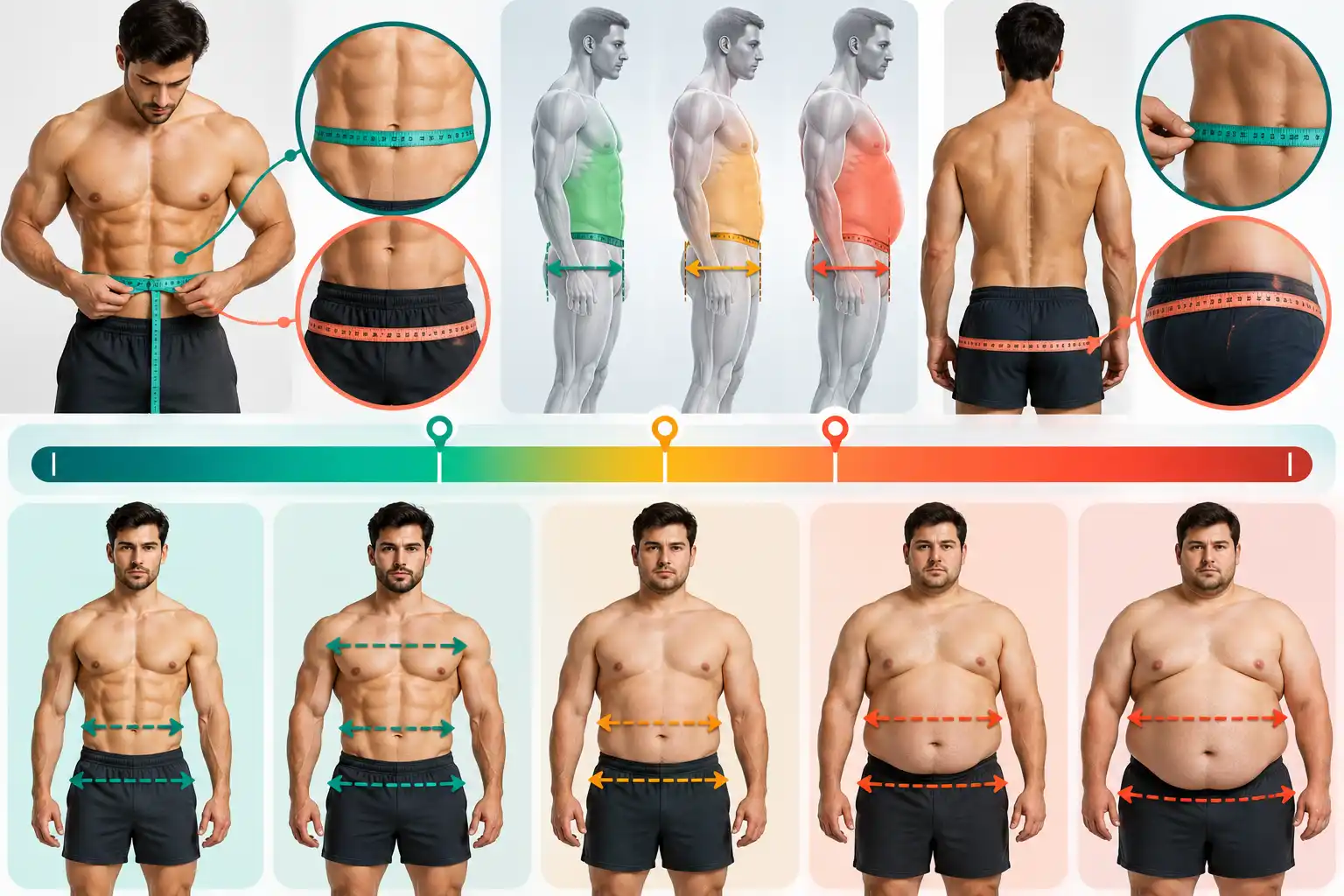
The ratio also has limits. If waist and hips grow together, it can stay flat while risk rises, and very muscular hips can flatter it. That’s why it’s usually read alongside other measures, such as waist circumference. Where you place the tape matters too. WHO’s protocol puts the waist halfway between the lowest rib and the top of the hip bone, and the hips at the widest part of the buttocks, so a reading taken at the narrowest point or at the belly button can come out different.
None of this is a diagnosis. An oval result describes proportion, not a medical finding. If you’re concerned about your health, a doctor can put your numbers in context.
Fit
Why Off-the-Rack Clothes Fit
One Part and Miss Another
Ready-made clothes are cut for an assumed difference between the chest and the waist, and between the waist and the hips. If your proportions sit close to that assumption, a standard size fits everywhere. If they don’t, a garment fits one part and misses another, which is the fit problem most men describe without having a name for it.
Oval
A size chosen for your waist leaves extra room in the chest and shoulders, so look for cuts with more room through the midsection rather than sizing up everywhere.
Rectangle
Straight cuts usually fit. The common complaint is a lack of shape, not a lack of room.
Inverted triangle
You’ll usually buy for your chest and shoulders and then need the body of the garment taken in.
Triangle
You’ll tend to buy trousers a size above your shirts. Fit the hips first, then take in the waist.
Trapezoid
Shirts cut straight through the body can look boxy at the waist, and tapered cuts follow your shape more closely.
Tailors can usually take in a waist more easily than they can rework shoulders, so if you’re choosing what to get right off the rack, start with the shoulders.
Over Time
What Can Change in a Male Frame, and What Can’t
Stays put
Your frame. The bones that set your shoulder width and the width of your pelvis stop growing in adulthood.
Moves
Everything layered on top. Muscle and fat change your chest, waist and hips, and where a particular man gains or loses fat first varies from person to person. Muscle mass also tends to decline gradually with age unless it’s maintained.
By our rules, that means your shape can change. Adding muscle through the chest raises your chest-to-hips ratio, which can nudge a rectangle toward trapezoid or inverted triangle. A waist that grows past both chest and hips moves you to oval, and a waist that shrinks can move you back out of it.
To track this fairly, remeasure the same way each time and at a similar time of day. The calculator can keep your previous results on your own device so the comparison is easy, and you can clear that history whenever you like.
Why Trust This Calculator’s Rules

Daniel Carter
13 Days Ago
I liked how simple the calculator was. I entered my measurements and got a result in seconds. The explanation made it easier to understand how my chest, waist and hips relate to my body shape.
Michael Brooks
04 Days Ago
Most tools just give you a result without explaining much. I appreciated that this one shows how the measurements are used and what the result actually means.
Ryan Mitchell
01 Days Ago
I always thought body type was mostly about being skinny or muscular. This helped me understand how proportions play a role too. It’s a useful tool if you’re curious about your build.
Rohit Sharma
21 Days Ago
The instructions were clear, and I didn’t have to sign up or answer unnecessary questions. I also liked that it explains the calculator’s limitations instead of claiming to tell you everything about your body.

How We Calculate Your Result
The five shape rules in the table above are our own, and every cutoff is stated so you can check it. Your numbers are tested in order (oval, triangle, inverted triangle, trapezoid), and the first match decides your main result. If a deciding ratio is within 2 percentage points of a cutoff, the neighboring shape is shown as “close to”. Waist-to-hip ratio is your waist divided by your hips.
Sources Referenced on This Page
- World Health Organization: waist-to-hip ratio above 0.90 as the abdominal obesity cutoff for men, as reported by reference sources
- U.S. National Institute of Diabetes and Digestive and Kidney Diseases (NIDDK): waist-to-hip ratio of 1.0 or higher for men, as reported by reference sources
- ELSA-Brasil study of abdominal obesity indicators (12,232 participants), via SciELO Brazil: waist-to-hip cutoffs of 0.90 to 0.92 for men
- MDCalc, waist-to-hip ratio page: the WHO measuring protocol, and advice to read the ratio alongside other measures
- Body shape rules: our own, with no external source
FAQ