
Free · Private · No Signup · For All Genders
Body Type Calculator: Find Your Body Shape
Grab a measuring tape and you’ll have your answer in seconds. This body shape calculator works for all women, men, gay, and even transgenders, tells you exactly which shape category you fall into, and shows your waist-to-hip ratio alongside it.
users find this calculator helpful
Body Type Calculator
Find your body shape in under a minute
Enter four measurements and get an instant body shape result. Private, accurate, and calculated directly in your browser.
Let's start with the basics
This helps us use the right measurement guide and result categories.
Upper body measurement
Measure at the fullest point, keeping the tape level and snug (not tight).
Waist measurement
Find your natural waist — usually the narrowest point above your belly button.
Hip measurement
Measure around the fullest part of your hips/seat.
—
—
Shoulders/Bust · Waist · Hips — plotted to scale
It · compares proportions · not size
How the Body Type Calculator Works
Look Here is the thing about our body shape calculator. Our calculator is not measuring how big you are. They’re measuring how your measurements relate to each other. Sounds simple right? It’s not, and that is exactly why so many people get confused looking at their result.
It Compares Proportions, Not Size
You know two people can wear completely different clothing sizes and luckly land on the exact same body shape? which is very bad for twins sisters Because shape comes down to the relationship between your bust or shoulders, your waist, and your hips — not the raw numbers themselves. Your waist is meaningfully smaller than your bust and hips? You’re probably falls at hourglass territory. Doesn’t matter if those measurements are small or large in absolute terms.
Female Mode vs. Male Mode
If you are a men switch calculator to male mode and the calculator changes what it is comparing: shoulders or chest, waist, and hips — rather then bust, waist, and hips. Men’s body shapes get sorted differently too (trapezoid, rectangle, oval, triangle, inverted triangle), because the proportions that matter for a male frame aren’t the same ones that matter for a female frame. Most calculators we tested treat men as an afterthought just (like women just kidding), tacked onto the bottom of a page built for women. We didn’t want to do that.
What “Primary Result” and “Alternate Result” Mean
Actually real bodies don’t always sort cleanly into one of five or six boxes. If your measurements sit close to the line between two shapes — say, your waist-to-hip difference is right on the close of hourglass and pear. I will show you both, with the more likely one listed first. That is not the calculator being indecisive. It is being honest about how classification actually works.
Most People Land Somewhere in Between
Got a result like “mostly rectangle, leaning toward apple“? You’re not some weird outlier. You are the norm, honestly. Bodies exist on a spectrum, not in discrete categories, and any tool that always spits out one confident label — no overlap, no nuance, ever is oversimplifying things. It’s not measuring you more accurately. It’s just hiding the messy part, i hope you understand this shape theory.
Getting the Terms Straight
What Is Your Body Type or Shape
“Body type” and “Body shape” are used reciprocally almost everywhere in the online world, including by us on this website, but it’s worth knowing there is a more precise version of each term if you dig deep down and go looking for it.
Body shape, in the sense this calculator measures, is about visible proportion — how your bust or shoulders, waist, and hips compare to one another. It’s the language of fit and styling: which cuts, which silhouettes, which necklines tend to work with your particular proportions.
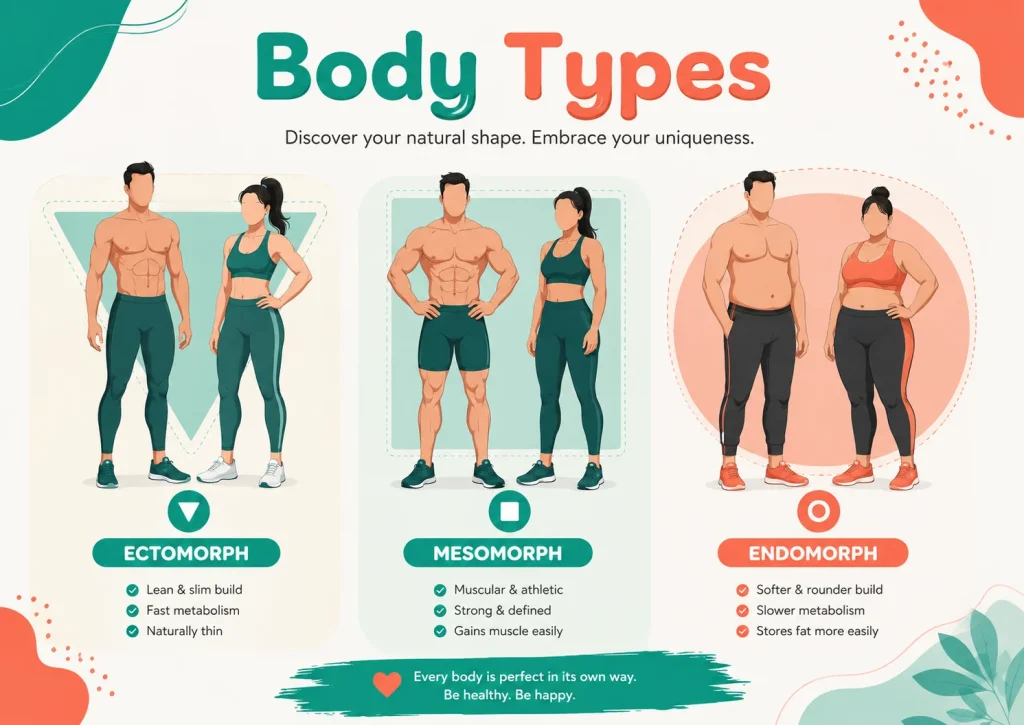
Body type, used more strictly, sometimes refers to something else entirely: somatotype (ectomorph, mesomorph, endomorph), a classification based on build and how a body consider to respond to training and diet, not current measurements. We cover the difference in more depth further down this page, because mixing the two up is one of the most common sources of confusion we see in this space.
For now, all you need to know: Just enter your measurements, and you’ll get your body shape → the proportion-based result → along with your waist-to-hip ratio → Things to Do – Things to Avoid.
Measure GuideFor Men, Women & Trans
Wrap the tape snug (not tight) around each area, parallel to the floor.
Tip: Measure in front of a mirror without heavy clothing for the most accurate body type result.
How to Measure
How to Measure Your Body for Accurate Results
This is the step where most inaccurate results actually come from — not a flaw in the calculator, but a measurement taken a little too loose, a little too tight, or in the wrong spot. Use a soft fabric measuring tape, not a metal one, and measure over light clothing or close-fitting underwear rather than bulky layers.
Bust or Chest
Wrap the tape on your fullest part of your bust (women) / (Transgender) or chest (men), keeping it level with the floor the entire way around — not angled up in the back, which is the single most common mistake here. Let the tape sit against your body without pulling it tight enough to compress anything.
Waist Measurement
Firstly, find your natural waist, the narrowest point of your torso, usually just a little higher than your belly hole, not wherever your pants happen to sit. Keep the tape snug but not tight, and breathe normally rather than sucking in.
Hips Measurement
Stand with your feet together and measure around the fullest part of your seat. Keep the tape level front to back it’s easy for it to ride up slightly in the back without you noticing, which throws the whole ratio off.
Add High Hip and Shoulder Measurements for Precision
High hip (optional but useful): About seven inches below your natural waist, across the upper hip bones. This one extra measurement helps the calculator tell the difference between a close apple result and a close rectangle result → two shapes that can look similar without it.
Shoulder Measurement for Male Mode
Measure from the tip of one shoulder straight across to the other, at the widest point. This is what stands in for bust measurement in the male version of the calculator.
See Your Shape and Ratio Instantly
Enter what you’ve got into the calculator above, and you’ll get your shape classification and your waist-to-hip ratio at the same time. If you only have three of the four measurements, that’s fine high hip is optional, and the calculator will tell you if a required field is missing rather than guessing.
Common Measuring Mistakes
That Skew Your Result
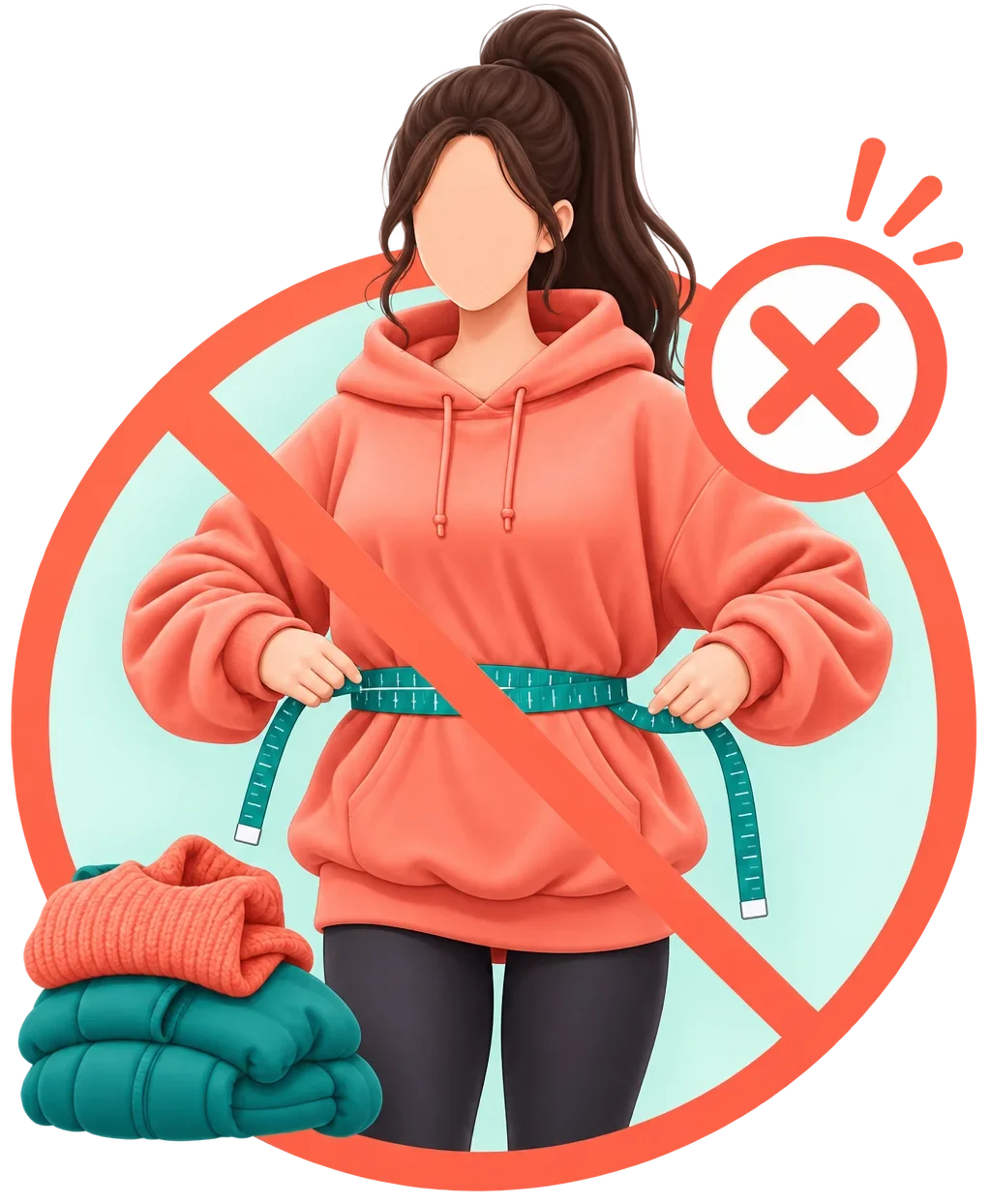
Measuring over bulky clothing
Even a thick sweater can add an inch or more. Measure over thin fabric or close-fitting underwear.
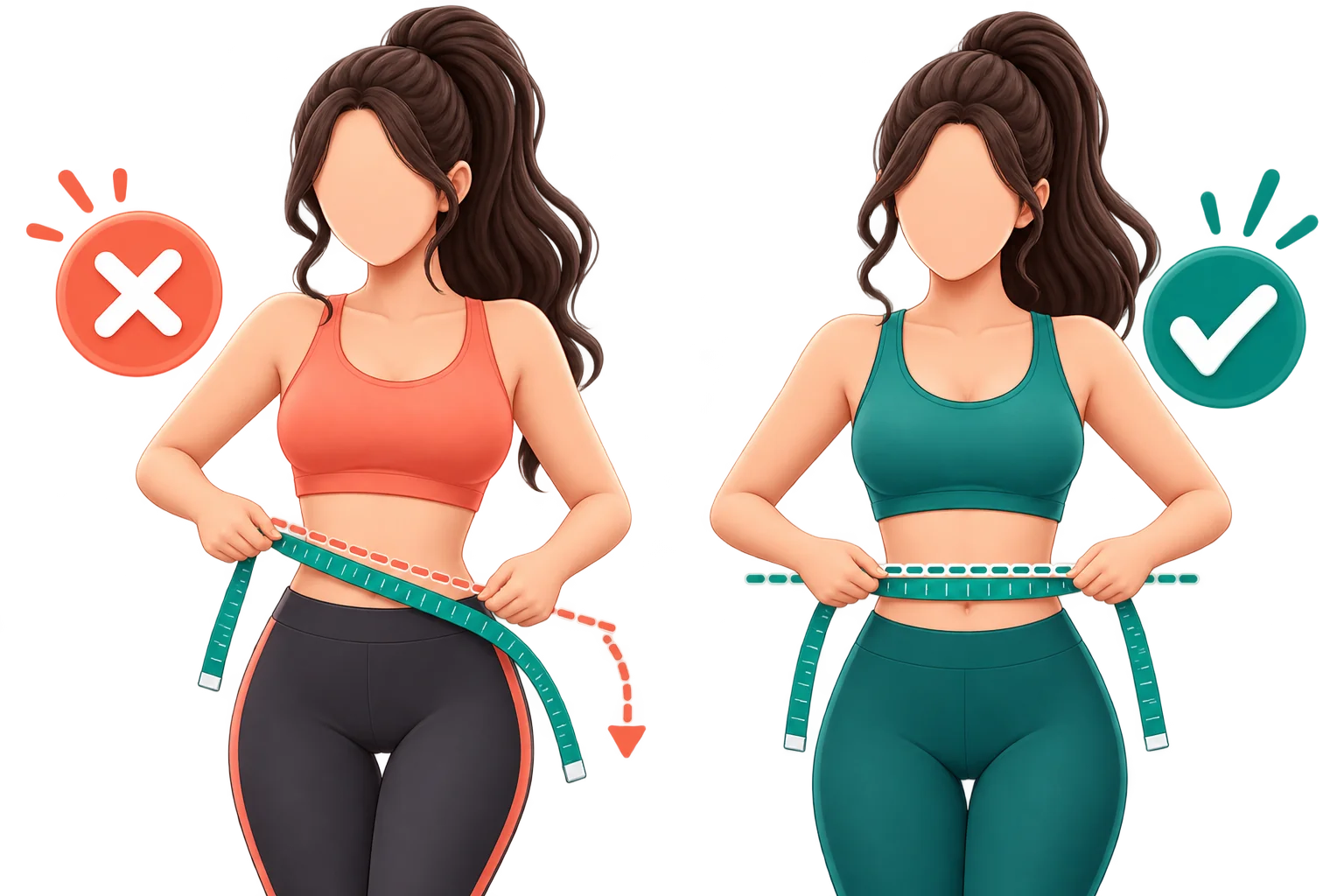
Letting the tape sag or angle.
A tape that isn’t level all the way around gives you a shorter number than your actual measurement.
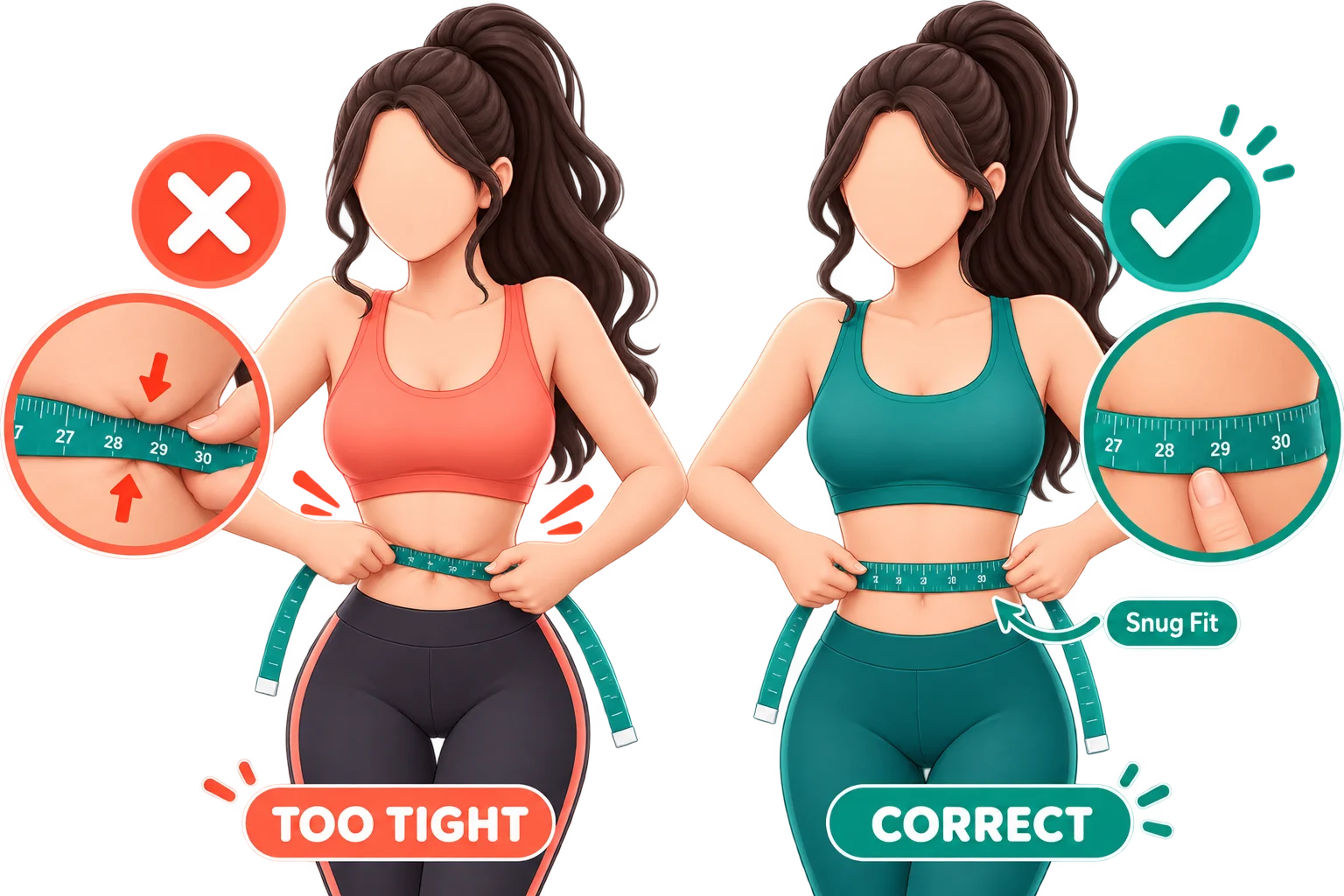
Pulling the tape too tight
This compresses soft tissue and gives a smaller reading than reality. Snug is correct; tight is not.
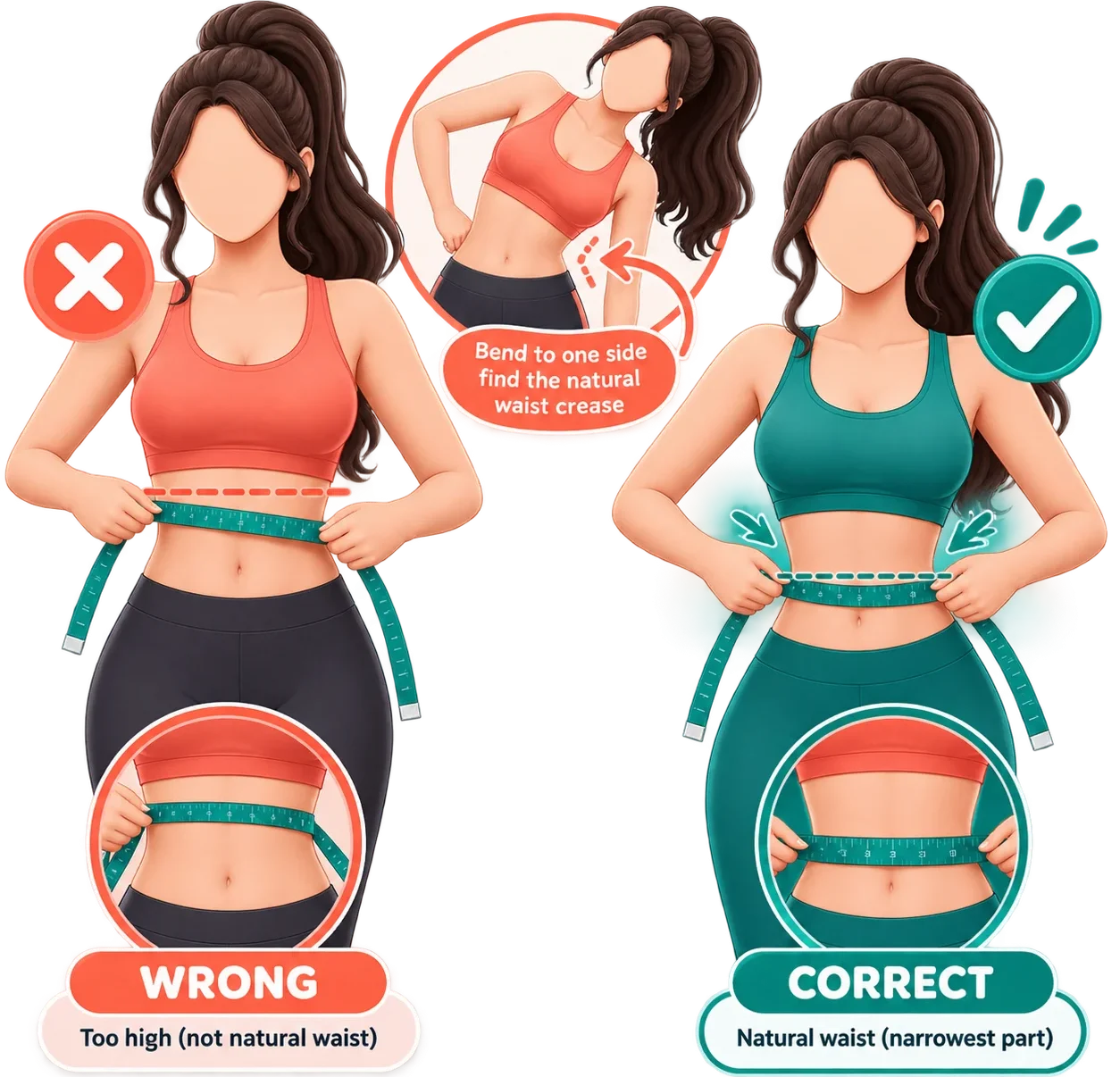
Mesuring at the wrong waist point
Bend slightly to one side; the crease that forms is usually your natural waist.
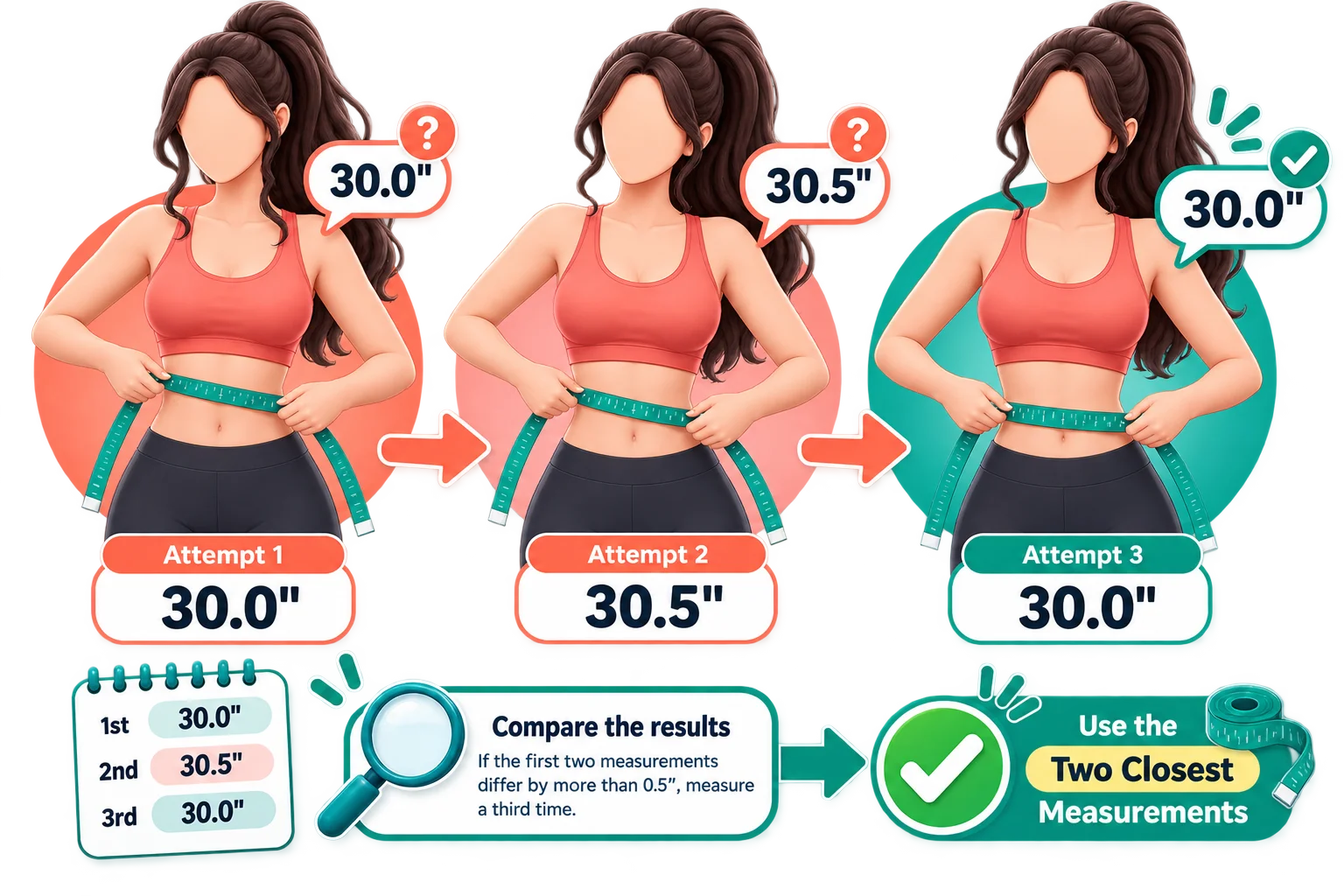
Only measuring once
If your first and second attempt differ by more than half an inch, measure a third time and go with the two closest numbers.
Transparency
See the Calculation in Action
Here’s what the math actually looks like, using a real set of sample numbers so you can see exactly how a result gets reached — not just take our word for it.
Bust 36″ · Waist 28″ · Hips 38″
- Bust minus waist = 8″. Hips minus waist = 10″. Both gaps are big enough to point to a clear waist definition rather than a straight, boxy shape.
- Your bust and hips sit close together, within about 2 inches while your waist comes in noticeably smaller than either one.
- That combination — bust and hips relatively close, waist meaningfully smaller than either — is the signature of a pear shape leaning toward hourglass, which is exactly the kind of near-boundary result we mentioned earlier. The calculator would show pear as the primary result with hourglass noted as the close alternate.
Result: Pear (primary) → Hourglass (alternate)
Change just the hip number to 32″ instead of 38″, and the same bust and waist measurements now point toward rectangle instead, because the hip-to-waist difference drops from 10″ down to 4″ no longer enough of a difference to read as a defined waist. Small changes in one measurement can shift the result, which is exactly why accurate measuring in the first two steps matters more than anything else on this page.
Curvy Body Shape
What It Means and How to Measure It
“Curvy” gets searched almost as often as any single shape name, but it’s not actually one of the standard classifications. It is a description that applies mostly to hourglass and pear shapes, where there’s a noticeable difference between waist and hip (or waist and bust) measurements. The bigger the gap between your waist and your bust or hips, the more that curve shows up in the numbers, not just in how clothes happen to fit.
Worth saying plainly: curvy isn’t a size. A person in a smaller size and a person in a larger size can have the same proportional curve, and the calculator above will sort them into the same shape category even though their measurements in inches look nothing alike.
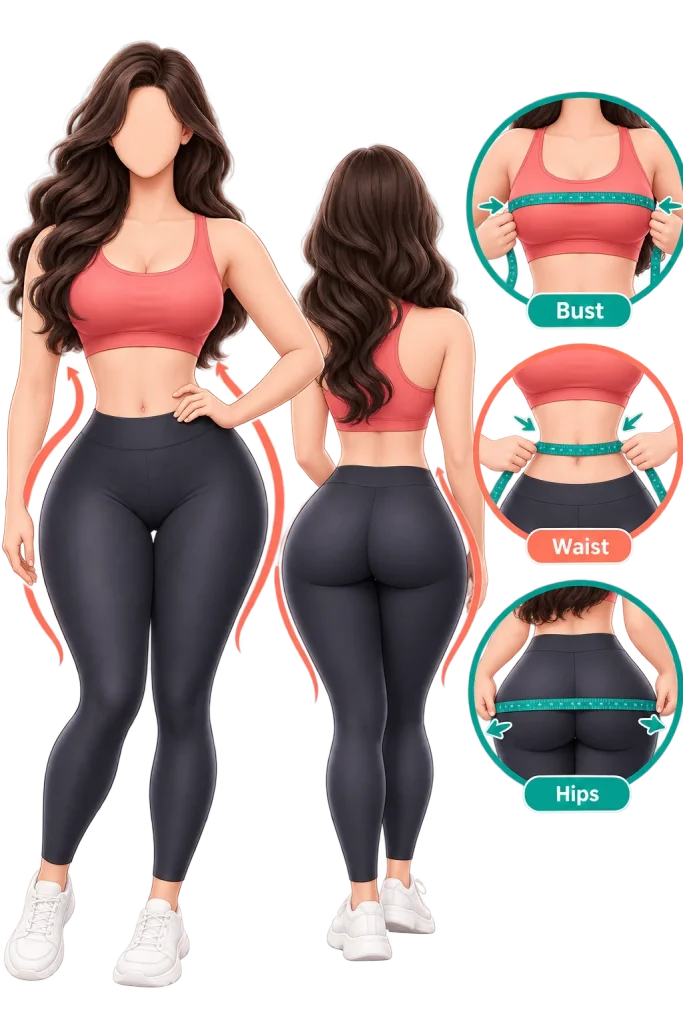
Female Body Types Calculator
You know body shape is all about proportions. By analyzing the relationship between your shoulders, bust, waist, and hips, our Female Body Types Calculator helps determine which body shape best represents your natural frame. The result provides a simple way to understand your silhouette, choose clothes that fit better, and appreciate the unique proportions that make your body your own.
What are the Common Body Shapes in Women
Hourglass Body Shape
Bust and hips measure close to each other, with a waist that’s clearly smaller than both usually a difference of several inches on each side. This is the shape most people picture when they hear “curvy,” though it’s not the only one that qualifies.
Pear (Triangle) Body Shape
Hips measure larger than bust or shoulders, with a defined waist in between. In several published measurement studies of women’s bodies, pear comes up as the single most common result — so if this is your shape, you’re in the majority, not an outlier.
Apple (Round) Body Shape
Fullness sits mainly through the waist and midsection, with the waist measuring close to both bust and hips rather than clearly smaller. This is also the proportion pattern connected to a higher waist-to-hip ratio, covered in the health section below.
Rectangle (Straight) Body Shape
Bust, waist, and hips all fall within a fairly narrow range of each other, without a sharply pulled-in waist. This is one of the most common shapes overall common precisely because it’s the least extreme outcome, not because anything is missing.
Inverted Triangle Body Shape
Shoulders or bust measure noticeably wider than hips, without enough waist definition to pull the result toward apple instead. Broad shoulders relative to hips are the defining signal here. If you really struggling to identify your body type try our body type calculator
Spoon Body Shape
Hips measure larger than bust, similar to pear, but with an added shelf of fullness at the high hip that a standard pear measurement doesn’t fully capture. This is exactly why the optional high-hip measurement exists without it, spoon and pear are easy to confuse.
Oval / Diamond Body Shape
Weight sits mainly through the midsection, similar to apple, but with a narrower bust and hip line by comparison, and often less waist definition. Most calculators lump this into apple by default we didn’t, because the proportions genuinely read differently once high-hip and shoulder numbers are in the picture.
None of these seven categories describes your health, your fitness, or your worth only the relationship between a handful of measurements. Plenty of real people sit right between two of these, and if that’s you, the calculator’s alternate-result feature exists for exactly that reason.
Women Body Shape Chart
Enter your bust, waist, hips, and (optionally) high hip below to see exactly where you land, including your closest alternate shape if your numbers sit near a boundary.
|
Body Type |
Bust (in) |
Waist (in) |
Hips (in) |
|---|---|---|---|
|
Rectangle |
34–38 |
28–32 |
34–38 |
|
Triangle (Pear) |
32–36 |
28–32 |
36–42 |
|
Inverted Triangle |
36–40 |
28–32 |
32–36 |
|
Spoon |
30–34 |
26–30 |
40–44 |
|
Top Hourglass |
36–40 |
24–27 |
34–38 |
|
Hourglass |
34–38 |
26–28 |
36–40 |
|
Bottom Hourglass |
32–36 |
25–28 |
38–42 |
Body Type Calculator for Men
Ever wonder why a T-shirt fits your shoulders perfectly but feels tight around your waist, or why trousers, hoodies, jackets, and suits never seem to fit quite right? The problem is often not the size it’s your body shape.
Our male body type calculator helps you understand your natural proportions so you can choose clothes that fit and flatter your frame. If you’re calculating a male body shape, simply switch to Male Mode. The calculator compares your shoulders (or chest), waist, and hips using proportions designed specifically for men.
Unlike many calculators that focus mainly on female body types, this tool includes five dedicated male body shapes to provide more accurate results, better sizing guidance, and smarter outfit recommendations.
What Are the Common Body Shapes in Men
Trapezoid
Shoulders measure visibly broader than the waist, without either extreme a balanced, athletic-leaning proportion.
Rectangle
Shoulders, waist, and hips sit close in width to each other, without a pronounced taper — one of the more common male results.
Oval
More fullness through the midsection than shoulders or hips. The male result most closely tied to waist-to-hip ratio and health.
Triangle
Hips or lower body measure broader than the shoulders — the reverse of trapezoid. Less common, but a real, distinct pattern.
Inverted Triangle
Shoulders measure clearly broader than hips, more pronounced than trapezoid. Broad shoulders relative to a narrower lower body are the defining signal.
What If Your Measurements Fall Between Two Body Shapes?
Not everyone fits perfectly into a single body shape category. If your measurements are very close to the boundary between two shapes, the calculator may show a primary body shape along with a secondary match. This simply means your proportions share characteristics of both categories.
That’s completely normal and actually makes the result more accurate and precise. Instead of forcing your measurements into one box, the calculator highlights the shape that matches best while also showing the closest alternative. This gives you a very clear understanding of your body proportions and helps you make better decisions when choosing clothing styles, fits, and sizes.
Male Body Shape Chart
Switch to Male Mode and enter your shoulder (or chest), waist, and hip measurements. The calculator will identify your body shape and calculate your waist-to-hip ratio based on your proportions.
Please remember use accurate measurements for the most reliable result and better clothing fit recommendations.
|
Body Type |
Bust (in) |
Waist (in) |
Hips (in) |
|---|---|---|---|
|
Rectangle |
34–38 |
28–32 |
34–38 |
|
Triangle (Pear) |
32–36 |
28–32 |
36–42 |
|
Inverted Triangle |
36–40 |
28–32 |
32–36 |
|
Spoon |
30–34 |
26–30 |
40–44 |
|
Top Hourglass |
36–40 |
24–27 |
34–38 |
|
Hourglass |
34–38 |
26–28 |
36–40 |
|
Bottom Hourglass |
32–36 |
25–28 |
38–42 |
Health Context
Waist-to-Hip Ratio and
What It Means for Your Health
Your body shape result and your waist-to-hip ratio (WHR) come from the same measurements, but they are not the same thing because shape is about proportion and how your clothes fit. WHR is one of the few numbers in this whole space with real, sourced health context behind it, so it gets treated differently here.
What Is a Healthy Waist-to-Hip Ratio?
Waist-to-Hip Ratio — Health Risk Range
Note: Ratios above these thresholds are associated with higher health risk in population studies. This is a general reference, not a diagnosis.
Actually, WHR is simply your waist measurement divided by your hip measurement. The World Health Organization uses 0.85 for women and 0.90 for men as the threshold above which fat distribution is associated with higher health risk. Below those numbers doesn’t guarantee good health, and above them doesn’t guarantee a problem, but please remember it’s one data point, not a verdict or final word.
WHR and Cardiovascular Health Risk
Carrying more weight around the waist relative to the hips has consistently been linked to higher cardiovascular and metabolic risk, independent of a person’s overall size. This is part of why WHR gets used in health research alongside — sometimes instead of — BMI: two people with identical BMI can have very different WHRs.
None of this is a diagnosis. Genetics, muscle mass, age, activity level, and overall health all factor in, and a single ratio from a home measurement can’t account for any of that. If you have real concerns about your health, a doctor is the right person to put your specific number in context — not a calculator.
Apple Shape vs. Pear Shape
Fat Distribution and Health
|
Apple Shape |
Pear Shape |
|---|---|
|
Wider Waist |
Wider Hips |
|
Upper Body Focus |
Lower Body Focus |
|
Higher WHR |
Lower WHR |
|
Midsection Weight |
Hip Weight |
|
Straighter Silhouette |
Curvier Silhouette |
|
Broad Midsection |
Defined Waist |
|
Waist Dominant |
Hip Dominant |
Body Shape vs. Body Type vs. Somatotype vs. BMI
Four terms, four different things
Almost everyone including plenty of other calculators, uses at least two of these interchangeably. Here’s where each one actually stands.
Proportion
Body Shape
What this calculator measures. The relationship between your bust or shoulders, waist, and hips, sorted into categories like hourglass, pear, and rectangle. Says nothing about health, fitness level, or muscle versus fat.
Build
Somatotype
A separate, older classification system ectomorph, mesomorph, endomorph, based on general build and how a body tends to respond to training and diet, not current measurements. Most real people are some blend of the three, shaped by genetics, hormones, and environment working together, not any single factor alone.
Style
The Kibbe System
A more detailed classification used in fashion styling, built around bone structure, body shape, and facial features, sorting people into more granular categories than the five or seven shapes covered on this page. A deeper rabbit hole than most people need, but a genuinely different, more detailed system — not just another name for the same thing.
Weight
BMI
Body mass index compares your weight to your height, with no proportion component at all. Two people with the same BMI can have completely different body shapes. If you land on a BMI result while looking for a body shape calculator, you’re looking at a different tool answering a different question.
Clinical
Body Composition
Scans (DEXA)
A tape measure and a calculator give you proportion and a rough health signal — useful, quick, free. A DEXA scan, done clinically, gives you an actual breakdown of fat mass, muscle mass, and bone density, which no home measurement can. If your goal depends on precise body composition numbers, that’s the tool that gets you there, not this one.
Beyond fitting into a label
Why Your Body Shape Matters
Knowing your shape isn’t about earning a title. It’s useful in a few concrete ways, and not much beyond that.
Choosing Clothing That Fits Your Proportions
A garment cut for a defined waist will sit differently on a rectangle result than an hourglass result, even in the same size. Knowing your shape means you can predict which cuts are worth trying on and which ones are likely to need alteration, before you buy.
Setting Realistic Fitness and Training Goals
Shape describes your current proportions, not your ceiling. If your goal involves changing how your body looks, knowing your starting shape gives you a baseline to track against nothing more, nothing less.
Tracking Changes Over Time
Remeasuring every few months, especially through a period of weight change, training, or just getting older, shows you real shifts in proportion that a mirror alone is easy to misjudge.
Quick Styling Guide by Body Shape
A starting point, not a rule
A short starting point for each shape full guides with more detail are linked from each shape section above.
Hourglass
Look for cuts that follow your natural waist rather than hanging straight past it, wrap styles and fitted waistbands tend to work with this shape rather than against it.
Pear
Structure through the shoulders (jackets, statement sleeves) helps balance a fuller hip line.
Apple
Fabrics that skim rather than cling through the midsection, with definition created higher up.
Rectangle
Belts, peplum details, and structured fabric can create shape rather than relying on the body to provide it.
Inverted Triangle
Fuller or patterned bottoms and simpler tops help balance broader shoulders against narrower hips.
Can Your Body Shape Change Over Time?
Yes — and that’s normal
Yes. Weight change, training, age, hormonal shifts, and for many women, pregnancy, can all move where you carry weight and how your proportions read — even though your underlying skeletal frame stays largely the same. If you measured yourself two years ago and get a different result today, that’s a real change, not a measuring error, though it’s worth remeasuring carefully to rule that out too.
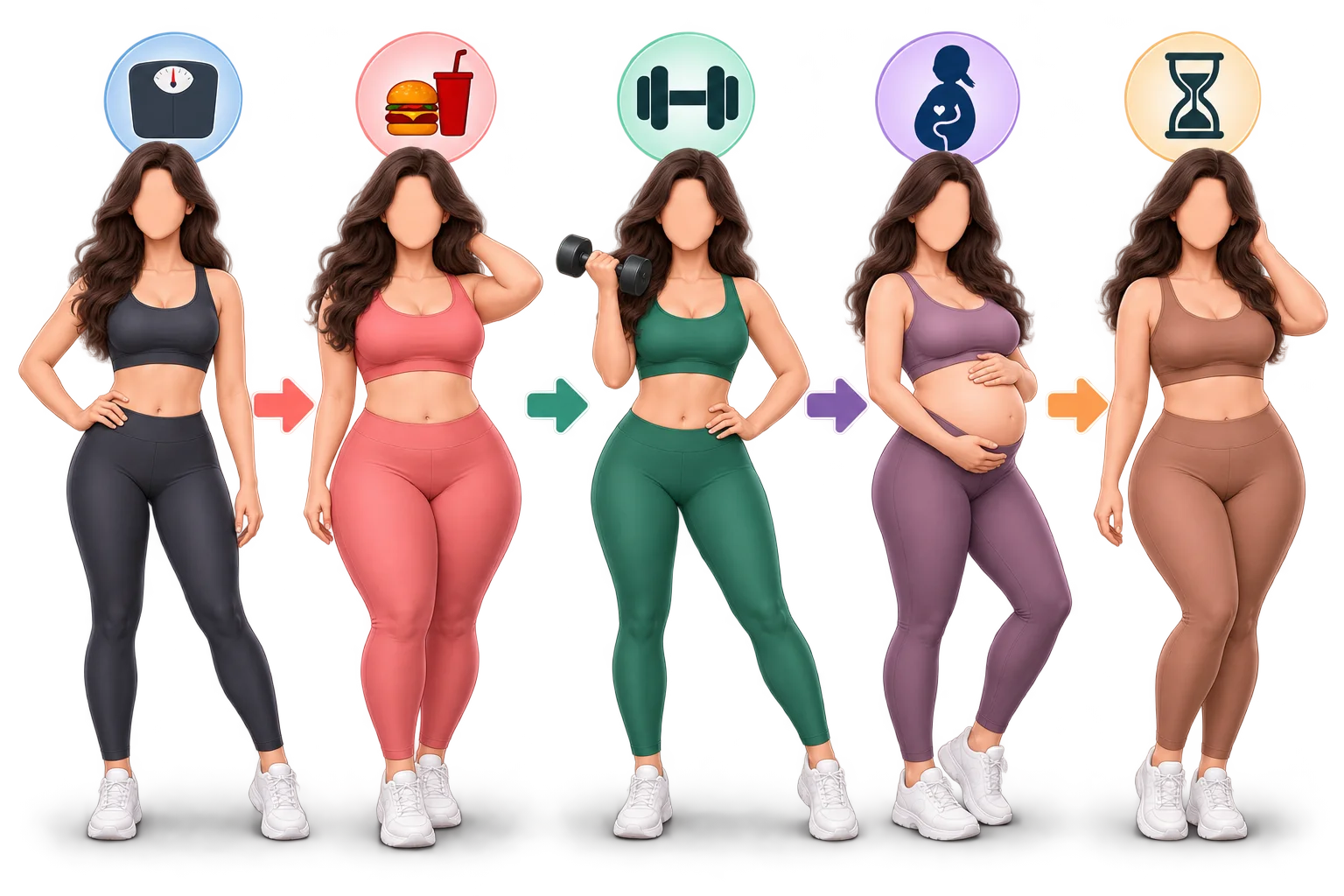
How to Train Differently Based on Your Body Type
Body shape doesn’t prescribe a training program, proportion isn’t a fitness plan. But if you’re working from a somatotype framework instead (see the disambiguation section above), the general, widely-discussed patterns are: a naturally lean, ectomorph-leaning build often responds well to progressive strength work and higher calorie intake to support muscle gain, a mesomorph-leaning build tends to respond readily to a mix of strength and moderate cardio; an endomorph-leaning build often does well with a combination of resistance training and consistent cardiovascular activity. These are general tendencies, not guarantees, genetics, current fitness level, and consistency matter more than which category you fall into. A trainer or coach who can see how your specific body responds will always beat a general framework like this one.
Why Trust This Body Type Calculator
Trusted by people worldwide, our calculator tools help users of every gender understand their measurements, body proportions, and personal fit with confidence.
Reviewed By

Amanda James
13 Days Ago
I always thought body shape was about size, but this calculator showed me it’s really about proportions. Very informative and easy to use.
Sarah Williams
03 Days Ago
The calculator was surprisingly accurate. It helped me understand why certain clothing styles fit me better than others and finally gave me a clear body shape result.
Drishti Singh
01 Days Ago
The step-by-step instructions helped me avoid common measuring mistakes. The final result matched my experience with clothing fit almost perfectly.
Maryam Ejaz
08 Days Ago
Clean design, clear explanations, and helpful visuals. I’ve recommended it to several friends who wanted to understand their body shape better.
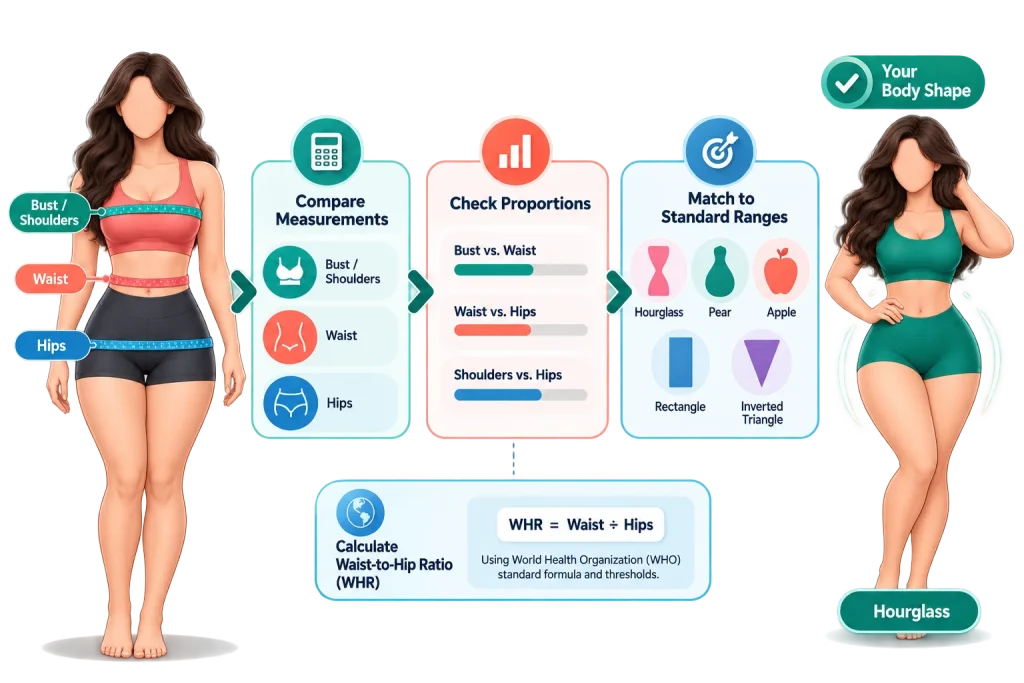
How We Calculate Your Result
This calculator compares the differences between your bust or shoulders, waist, and hips against standard proportional thresholds used across body-shape classification methods, then sorts the result into the closest matching shape, showing an alternate result whenever your measurements sit close to a boundary between two categories, rather than forcing a single answer. The waist-to-hip ratio shown alongside your shape result is calculated using the World Health Organization’s standard formula and thresholds.
Limitations of Any Body Shape Calculator
A measuring tape and a formula can’t account for everything. Muscle mass, bone structure, posture, and where exactly you place the tape all introduce some variation. This tool gives you a solid, honest starting point based on your proportions not a clinical measurement, not a fitness diagnosis, and not a judgment of anything about you beyond four numbers.
FAQ