
Free · Private · No Signup · BUILT FOR WOMEN
Female Body Type Calculator:
The One That Doesn’t Call Every Curve a “Pear”
Enter your bust, waist, high hip and hips, and this calculator sorts you into one of seven research-based shapes — not just the four everyday labels most tools stop at. Triangle, spoon, top hourglass, bottom hourglass: real differences most calculators flatten into one word.
users find this calculator helpful
Female Body Type Calculator
Find your body shape in Seconds
Get a personalized body shape result based on your real measurements.
Let's start with the basics
This helps us use the right measurement guide and result categories.
Upper body measurement
Measure at the fullest point, keeping the tape level and snug (not tight).
Waist measurement
Find your natural waist — usually the narrowest point above your belly button.
Hip measurement
Measure around the fullest part of your hips/seat.
—
—
Shoulders/Bust · Waist · Hips — plotted to scale
Why it’s for female
Female Body Shape Calculator
“Pear” is doing a lot of work for one word. It’s routinely used for at least three different proportions that don’t fit clothes the same way. This calculator doesn’t stop at pear. It uses four measurements bust, waist, high hip and hip to sort you into one of seven shapes from published research on women’s bodies: hourglass, top hourglass, bottom hourglass, spoon, triangle, inverted triangle or rectangle. Below the tool, we show you the exact rule behind each one, so if your result surprises you, you can check the math yourself instead of taking our word for it.
This page is built for telling apart shapes that look alike from the outside — pear versus spoon, hourglass versus bottom hourglass — where one extra measurement changes the answer. If you just want a quick read that works for both women and men, our main body shape calculator does that in under a minute.
How the Female Body Shape Calculator Sorts You Into 7 Categories
The seven categories come from a study of women’s body shapes by Jeong Yim Lee, Cynthia Istook, Yun Ja Nam and Sun Mi Park, published in the International Journal of Clothing Science and Technology in 2007. The rules on this page follow the version of that framework published in the study. We haven’t read the paper’s full text ourselves, so if you need the original thresholds, go to the paper.
Every rule is a subtraction: bust minus hips, hips minus waist, and so on, in inches. One extra number, high hip divided by waist, is used for one job only: splitting two shapes that look almost identical otherwise. That’s why the calculator asks for a high hip measurement. Without it, it can’t tell a spoon from a bottom hourglass.
Your high hip is the circumference around the upper swell of the hip, about 7 inches (18 cm) below your natural waist.
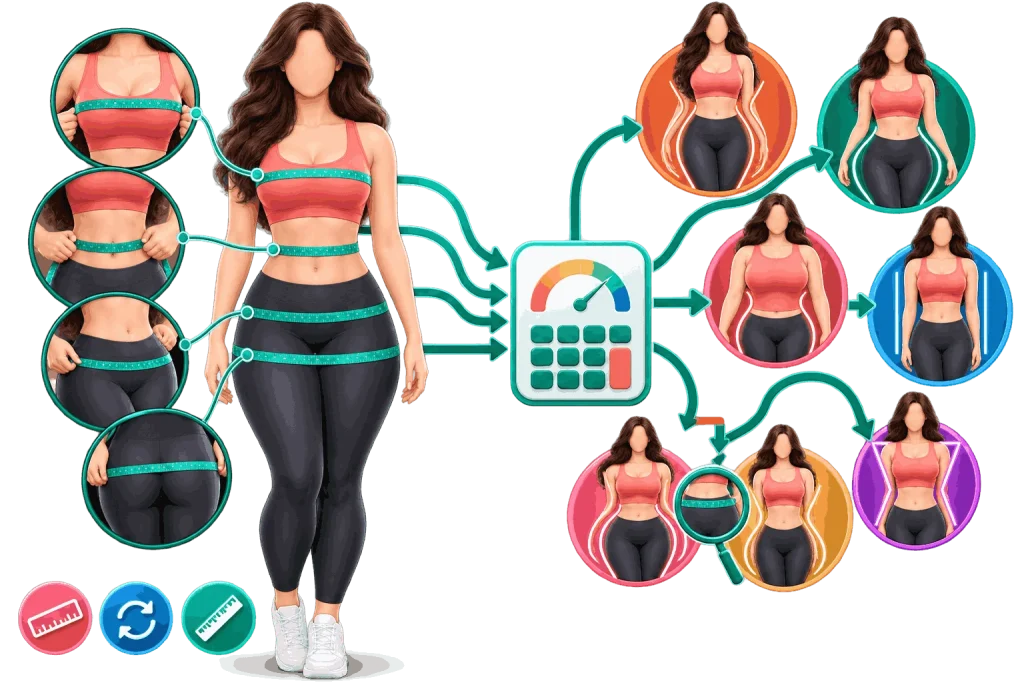
Three things to know before you read a result:
The rules are written in inches.
If you measure in centimeters, divide by 2.54 to check any rule by hand.
Some bodies fit none of the seven.
The framework itself says some shapes may not match any listed category, so a result that doesn’t feel right isn’t necessarily your mistake.
Half an inch can change the answer.
If your numbers sit close to a cutoff, measure again before you decide.
The 7 Female Body Types and Their Measurement Rules
Here are all seven rules side by side. The “published rule” column is the framework as the sea of the internet states it, in inches.
|
Shape |
In plain Text |
Published rule (inches) |
|---|---|---|
|
Hourglass |
Bust no more than 1″ bigger than hips, hips less than 3.6″ bigger than bust, waist clearly smaller |
(bust − hips) ≤ 1″ and (hips − bust) < 3.6″, and (bust − waist) ≥ 9″ or (hips − waist) ≥ 10″ |
|
Top hourglass |
Bust somewhat bigger than hips, defined waist |
(bust − hips) > 1″ and < 10″, and (bust − waist) ≥ 9″ |
|
Bottom hourglass |
Hips 3.6″–10″ bigger than bust, defined waist, fullness not right under the waist |
(hips − bust) ≥ 3.6″ and < 10″, (hips − waist) ≥ 9″, and high hip ÷ waist < 1.193 |
|
Spoon |
Hips clearly bigger than bust, defined waist, fullness starting right under the waist |
(hips − bust) > 2″, (hips − waist) ≥ 7″, and high hip ÷ waist ≥ 1.193 |
|
Triangle |
Hips 3.6″+ bigger than bust, less waist definition |
(hips − bust) ≥ 3.6″ and (hips − waist) < 9″ |
|
Inverted triangle |
|
(bust − hips) ≥ 3.6″ and (bust − waist) < 9″ |
|
Rectangle |
Bust and hips within 3.6″ of each other, little waist definition |
(hips − bust) < 3.6″, (bust − hips) < 3.6″, (bust − waist) < 9″, and (hips − waist) < 10″ |
For centimeters: 3.6″ is about 9.1 cm, 9″ is about 22.9 cm and 10″ is about 25.4 cm.
One note for anyone coming from our homepage: “apple” and “oval/diamond” are everyday labels, not separate categories in this framework. By these rules, a body with a fuller midsection and little waist difference lands in rectangle, triangle or inverted triangle, depending on how bust and hips compare.
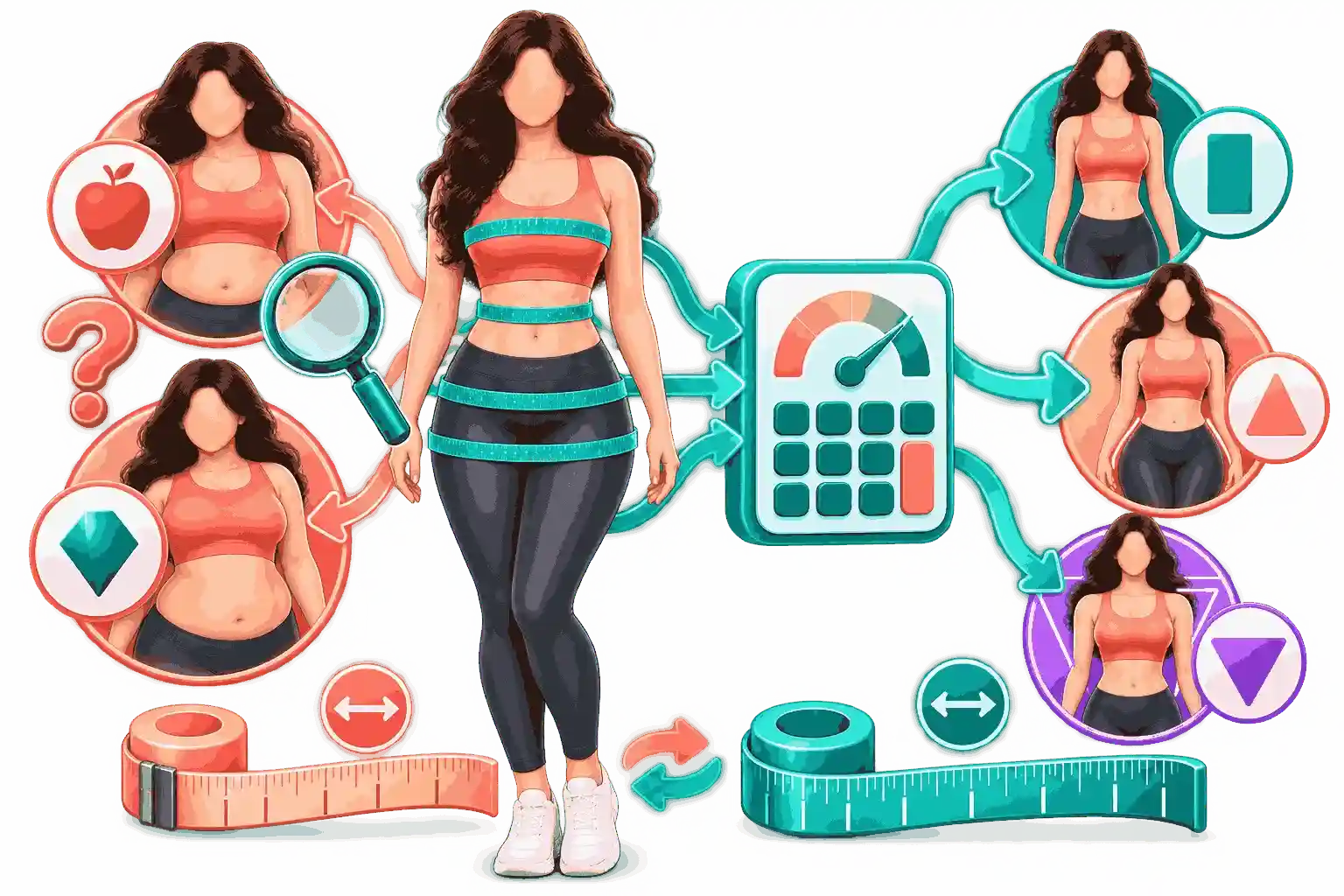
Hourglass Families
The Hourglass Family: Hourglass
Top Hourglass and Bottom Hourglass
All three have a clearly defined waist, roughly 9 inches or more smaller than the bust or hips. What separates them is which end is bigger. In a classic hourglass the two are balanced. In a top hourglass, the bust leads. In a bottom hourglass the hips lead by 3.6 to 10 inches, and the high hip is not much fuller than the waist.
Does this sound like you?
- Hourglass: the same size fits your bust and your hips, and the waist is where clothes gape or need taking in.
- Top hourglass: jacket and top sizes are set by your bust, while trousers and skirts in that size feel loose through the hips.
- Bottom hourglass: you size up for trousers and skirts to fit your hips, then take in the waist, while tops in a smaller size fit fine.
Triangle vs. Spoon: Why “Pear”
Covers Four Different Results
In everyday use, hips wider than the bust all get called pear. By these rules that group splits into four results: triangle, spoon, bottom hourglass and, at the edge, some hourglass measurements. Triangle is the one with less waist definition, because the waist sits less than 9 inches below the hips. Spoon keeps a defined waist but adds a shelf: the high hip is at least 1.193 times the waist, so the fullness starts almost immediately below it.
Does this sound like you?
- Triangle: trousers that fit your hips leave only a small gap at the waistband.
- Spoon: the same trousers gap noticeably at the back of the waistband, and the fullness starts just under the waist rather than lower down.
Rectangle and Inverted Triangle
Both have little waist definition, measured against the bust: less than 9 inches of difference. The bust-to-hip comparison decides between them. In a rectangle the two are within 3.6 inches of each other. In an inverted triangle the bust is at least 3.6 inches bigger.
Does this sound like you?
- Rectangle: the same size fits top and bottom, clothes hang straight through the middle, and a belt changes your shape instead of following it.
- Inverted triangle: your bust or shoulders set your size in jackets and tops, and you size down for skirts and trousers.
Transparency
Same Bust, Waist and Hips, Different Result
A worked example showing exactly how one extra measurement changes the answer.
Bust 34″ · Waist 27″ · Hips 38″
- Hips minus bust is 4″. That rules out hourglass (hips must be less than 3.6″ bigger than the bust), rectangle, top hourglass and inverted triangle.
- Hips minus waist is 11″. That rules out triangle, which needs less than 9″.
- Two candidates are left: bottom hourglass and spoon. Both fit all three measurements. Only the high hip can separate them.
|
High Hip |
÷ Waist (27″) |
Result |
|
33″ |
34–38 |
Spoon |
|
31″ |
32–36 |
Bottom Hourglass |
For a 27″ waist, the line sits at about 32.2″ (27 × 1.193). A high hip at or above that is a spoon, and below it is a bottom hourglass. Same bust, same waist, same hips, and a two-inch difference in one measurement changes the result. That’s why we ask for high hip, and why it’s worth measuring twice. There’s no obvious landmark to find it by, so it’s the easiest one to misplace.
Quick Estimate
How to Know Your Body Shape Without Measuring
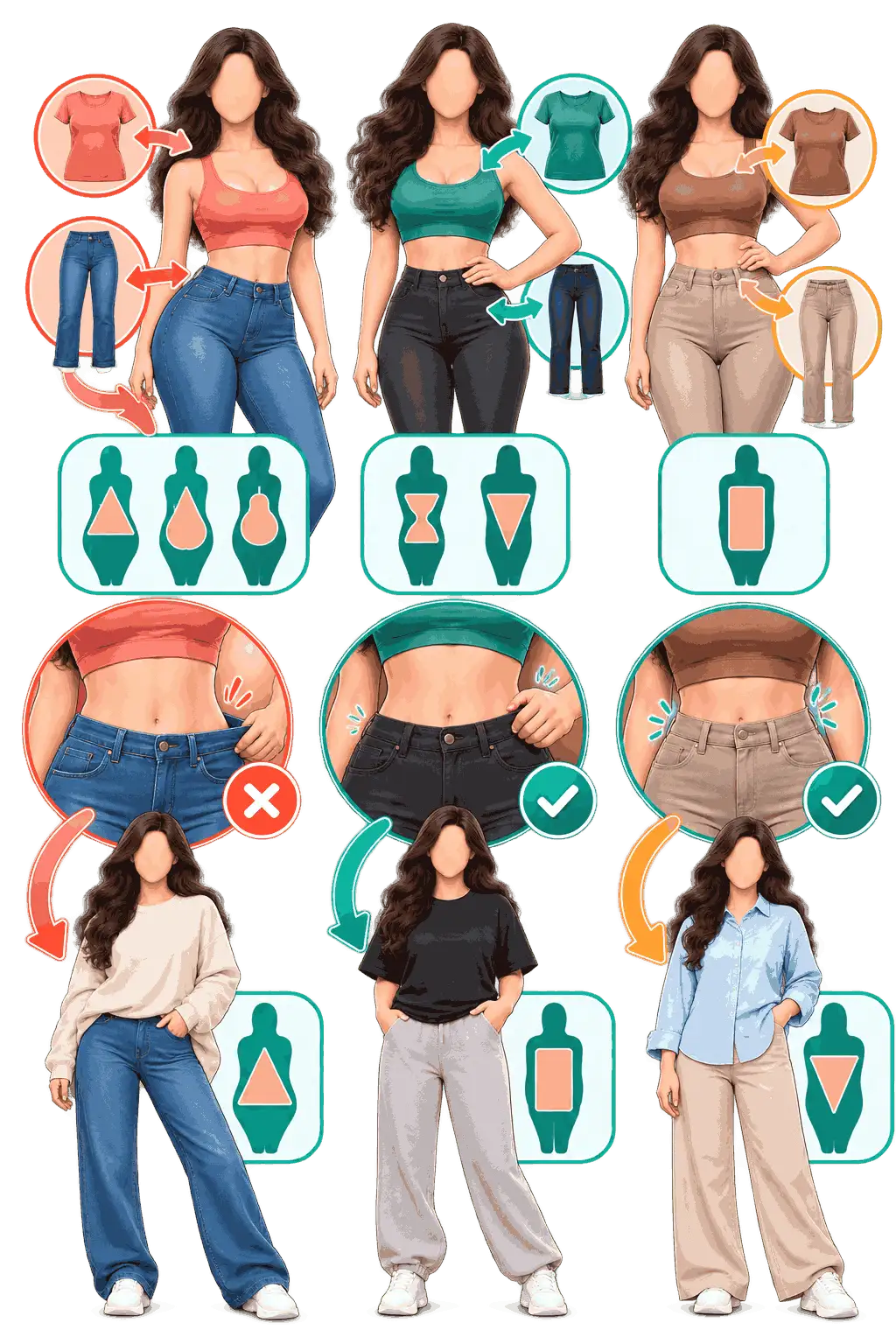
You can get a rough idea from how your clothes fit. It’s a guess, not a result, but it usually points at the right family of shapes:
- Different sizes on top and bottom. If you buy a bigger size for trousers and skirts than for tops, your hips lead (triangle, spoon or bottom hourglass). If it’s the other way round, your bust leads (top hourglass or inverted triangle).
- Waistband gaps. Trousers that fit your hips but gap at the waist suggest a defined waist. Little or no gap suggests less waist definition.
- Same size everywhere, hanging straight. That usually points to a rectangle.
Brands cut sizes differently and stretch fabric hides a lot, so these cues can mislead. A tape measure and the rules above are the only way to check.
Sourced Data
Which Female Body Shape Is the Most Common?
Rectangle, going by the numbers we can source internet reports a 2005 study of more than 6,000 women at North Carolina State University in which 46% were banana-shaped (its word for rectangle), just over 20% were pear-shaped, just under 14% were apple-shaped and 8% were hourglass-shaped. We haven’t seen the study itself, so treat these as reported figures.
Does this sound like you?
- “Apple” means something different here. Apple is listed as another name for inverted triangle: broader shoulders and bust than hips. That isn’t the round-midsection apple most other sites describe, so the roughly 14% probably refers to upper-body-led shapes.
- The figures don’t cover everyone. They add up to roughly 88%, and we can’t tell from here how the rest were classified.
- They don’t map one-to-one onto the seven shapes on this page. Those four labels are the fashion-industry categories. The seven-category framework comes from a different study that, going by its title, compared U.S. and Korean women, so the split in another country or age group could look different.
Is There a “Best” Body Shape for Women?
People search this a lot, usually as “most attractive female body shape” or “which body shape is best” None of the seven is better than another. The framework sorts measurements into groups so clothes can be matched to proportions. It doesn’t rank bodies. What’s considered attractive has shifted across cultures and decades, and sources says something similar about its own categories: they rest on subjective standards that differ between cultures.
If “best” means healthiest, that’s a different question, and shape doesn’t answer it. Where weight sits matters more than which silhouette you have, and we cover that in the waist-to-hip ratio section below. Even there it’s one data point, not a grade.
The question that actually helps is a smaller one which cut fits your proportions? That’s what the rules above are for.
Female Body Type Calculator With Height and Weight:
What It Can and Can’t Tell You
Some calculators ask for height and weight instead of a tape measure. That combination gives you BMI, which compares weight to height, not bust to waist to hips. It’s a different measurement answering a different question.
Two women can share a BMI and land in different shapes on this page, because BMI has no idea where the weight sits. It also can’t tell muscle from fat, so an athletic build and a higher-fat build at the same height and weight can post the same number. If a site asks only for height and weight and hands back a shape result, it’s estimating from averages, not measuring your actual proportions the way the calculator above does.
Height and weight are still worth knowing for other reasons; they’re just not a substitute for a tape measure here.
Beyond the Core Formula
Adding Shoulders to the Picture
The seven-category rules above run on bust, waist and hips. Shoulders aren’t part of that formula, but they’re worth measuring for a separate reason: two women with identical bust, waist and hip numbers can carry them very differently depending on shoulder width, and that changes how clothes actually sit.
Broader shoulders relative to your bust measurement tend to pull a look toward inverted-triangle styling even if your bust-to-hip numbers say rectangle or triangle. Narrower shoulders can do the opposite. If your calculator result and your mirror don’t fully agree, shoulder width is usually why, and it’s worth factoring in separately when you get to styling rather than expecting the seven-category formula to account for it.
Kibbe, Somatotype and Body Shape
Three Separate Systems
“Body type” gets used for at least three different systems, and women researching this page’s keywords are often looking for one of the other two without realizing it.
|
System |
What It Measures |
How You Find Out |
|
Body shape (this page) |
Bust, waist and hip proportions |
Tape measure, plugged into the rules above |
|
Somatotype |
Ectomorph, mesomorph, endomorph — general build and response to training/diet |
No tape measure; a general judgment call |
|
Kibbe System |
13 style categories: bone structure, body shape and facial features together |
Detailed questionnaire and visual assessment |
Kibbe for Women
The Kibbe system was developed for styling, not measurement. It sorts women into categories like Romantic, Dramatic, Natural, Gamine and Classic, plus combinations of these, based on whether the overall impression reads as sharper or softer, not on bust-waist-hip numbers. Two women with the same body shape result on this page can land in different Kibbe categories, because Kibbe is judging bone structure and features as well as proportion. If you searched for a Kibbe calculator and landed here, this page won’t give you that result a proper Kibbe assessment isn’t something a tape measure can do.
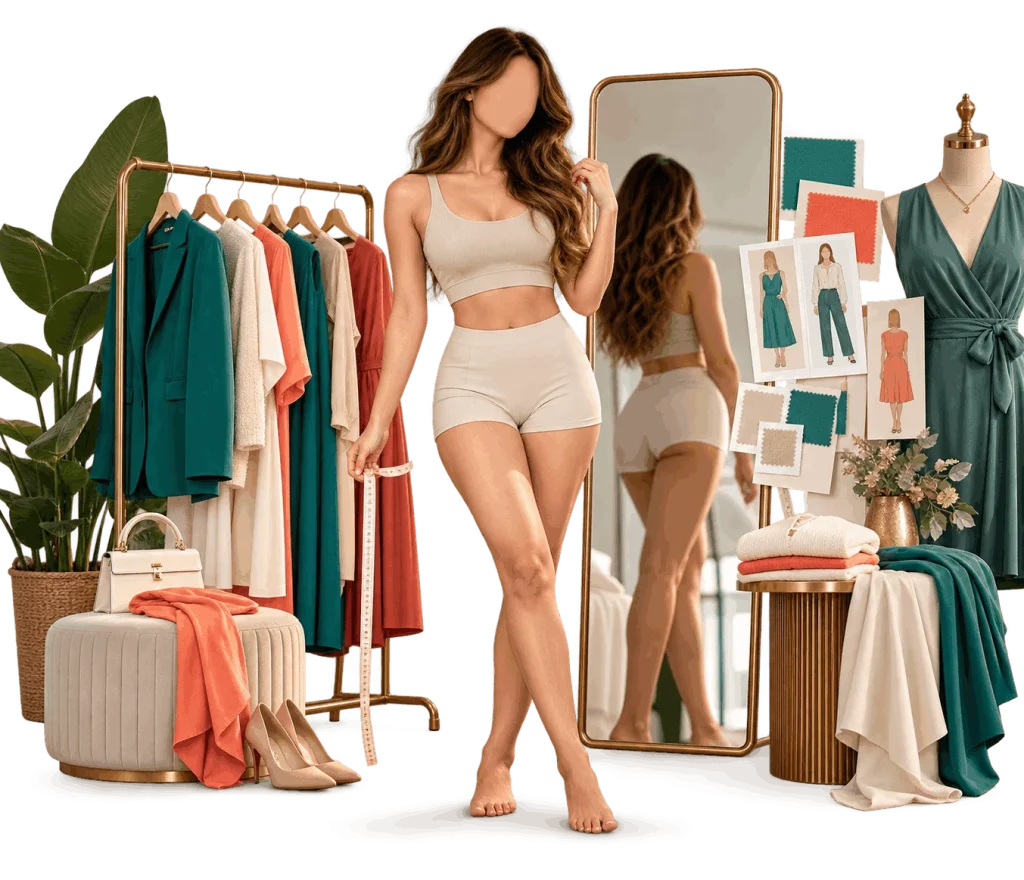
Endomorph, Mesomorph and Ectomorph in Women
Somatotype describes general build and tendency, not a specific shape. An endomorph-leaning build tends to carry more body fat and gain weight more easily. A mesomorph-leaning build tends to gain muscle relatively easily. An ectomorph-leaning build tends to stay lean with a narrower frame. None of the three maps cleanly onto hourglass, spoon, triangle or the other results above a mesomorph can be a rectangle or a triangle, an endomorph can be a bottom hourglass or an inverted triangle. Our main page covers this in more depth if you want the full picture for both men and women.
Health Context
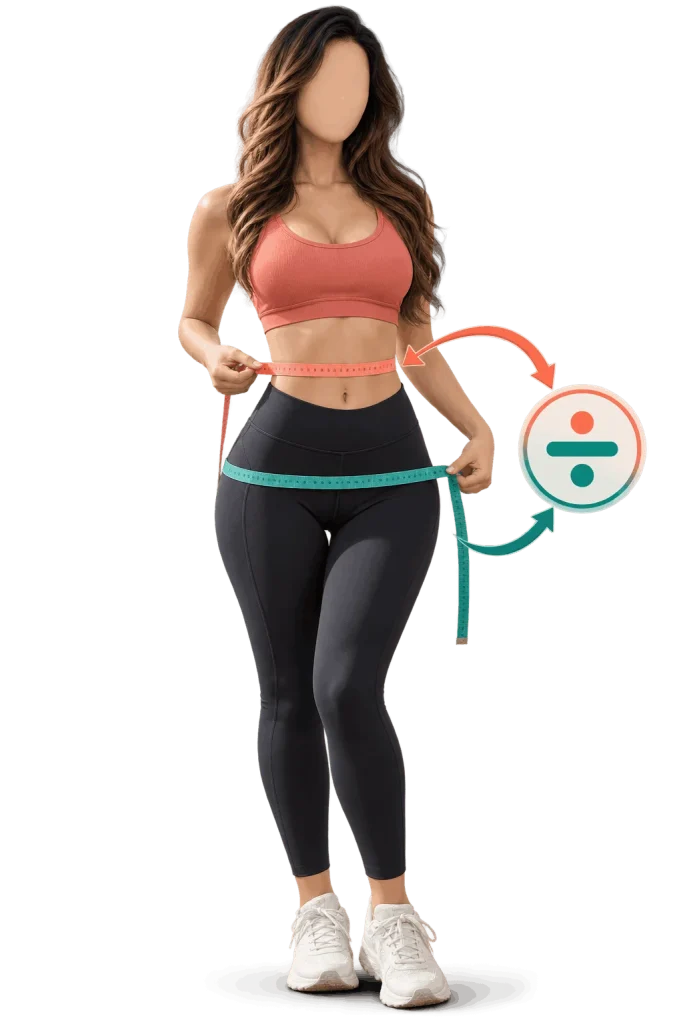
Waist-to-Hip Ratio for Women:
Why Sources Give Different Cutoffs
Waist-to-hip ratio is your waist measurement divided by your hip measurement, and it’s worth calculating alongside your shape result because, unlike shape, it has real health context behind it. Different health organizations don’t use identical cutoffs, though, and it helps to know that going in rather than treat one number as the only correct one.
Health Context
0.85
Threshold for women above which fat distribution is linked to higher health risk.
NIDDK (as cited by Giants)
~0.8
A different line for women, drawn in a similar place — not far enough apart to change what the result means.
The World Health Organization uses 0.85 for women as the threshold above which fat distribution is linked to higher health risk. The U.S. National Institute of Diabetes and Digestive and Kidney Diseases uses a different line, putting increased risk above roughly 0.8 for women, as reported on internet sources for this topic. Neither number is wrong; they’re different organizations drawing a line in a similar place, not far enough apart to change what the result means in practice: carrying weight around the waist relative to the hips is the pattern linked to higher risk, regardless of which exact cutoff you use.
A woman with a spoon or bottom hourglass shape, where hips lead, will generally see a lower waist-to-hip ratio than a woman whose fullness sits more through the waist. That’s the same measurements read for two different purposes: one for how clothes fit, one for a health signal. Neither one is a diagnosis on its own.
How Shape Changes
How a Woman’s Body Shape Changes: Pregnancy, Menopause and Age
Two life stages change female body shape more than most others, for reasons that are well documented rather than incidental.
Pregnancy
Pregnancy widens the hips partly through weight gain and partly because the hormone relaxin loosens the ligaments around the pelvis in preparation for childbirth. That looser, wider pelvis doesn’t always fully return to its earlier measurements afterward, which is why some women find their pre-pregnancy clothes fit differently for good, not just for a few months.
Menopause
Menopause shifts things a different way. Research on the menopause transition consistently links declining estrogen to a shift in where fat is stored — away from the hips and thighs and more toward the abdomen — independent of whether overall weight changes much at all. That’s a hormonal pattern affecting fat distribution, not a simple weight-gain story, and it’s part of why two women who weigh the same in their 30s and their 50s can measure very differently on this calculator despite the scale barely moving.
General aging
General aging adds a slower, ongoing factor: muscle mass tends to decline gradually with age unless actively maintained, which changes how the same skeletal frame carries weight even without menopause as a factor.
Why We Built It This Way
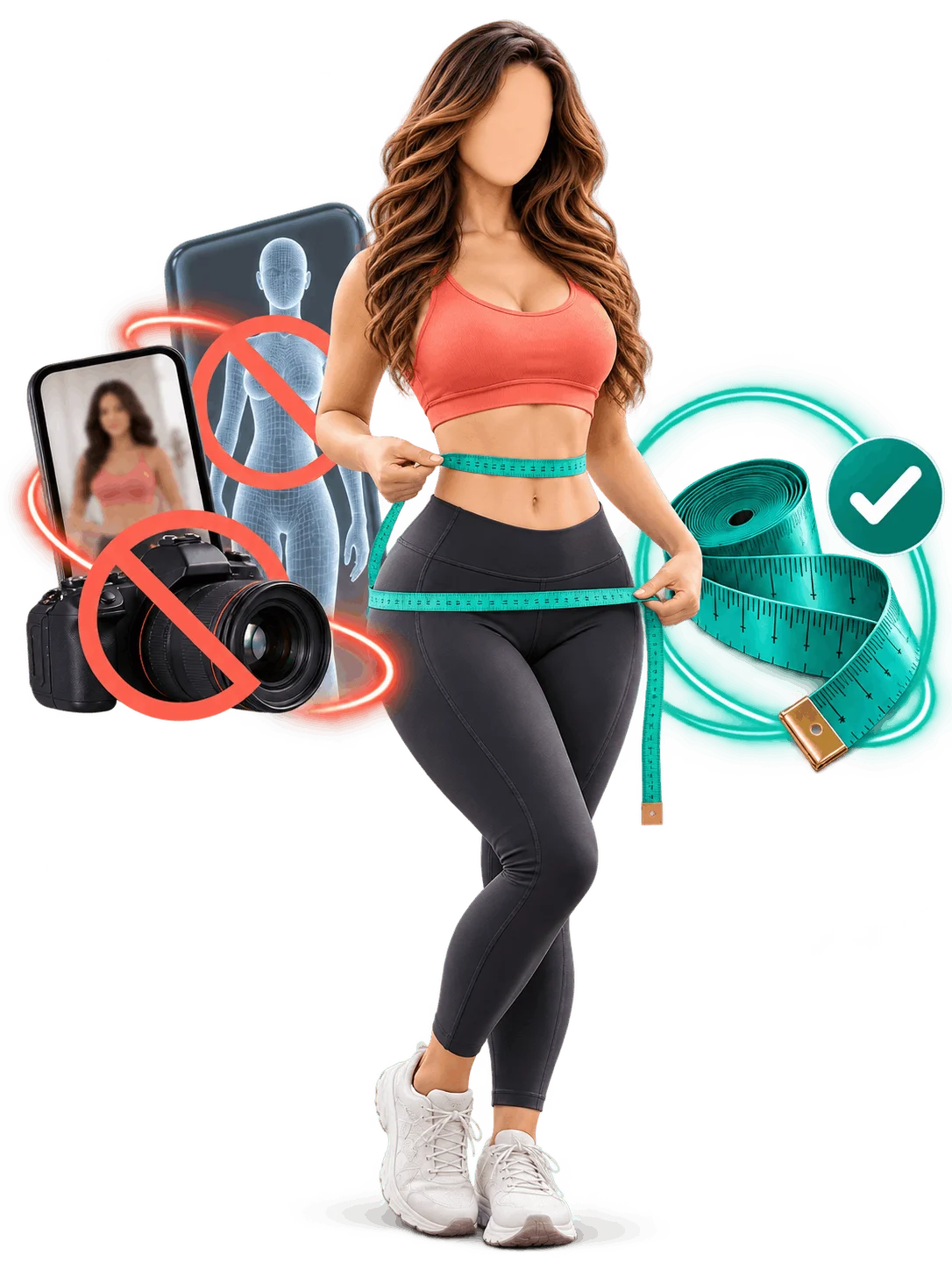
Why This Calculator Doesn’t Use Photos or 3D Models
Some sites offer to guess your shape from a photo or build a 3D model of your body. We didn’t build either, and it’s a deliberate choice, not a missing feature.
A tape measure gives you an exact number you can check by hand against the rules on this page. A photo-based estimate can’t do that it’s a visual guess, affected by camera angle, distance, clothing and lighting, with no way for you to verify how it reached its answer. A 3D model adds a rendering step on top of that same guess. Neither one is more accurate than measuring yourself with a soft tape, and both ask you to hand over a photo of your body to a website, which a tape measure never requires.
If accuracy and privacy both matter to you, four numbers and a tape measure beat a photo upload — that’s the whole reasoning behind how this tool works.
Why Trust This Female Body Type Calculator
Trusted by people worldwide, our female calculator tools help users to understand their measurements, body proportions, and personal fit with confidence.
Reviewed By

Amanda James
13 Days Ago
I always thought body shape was about size, but this calculator showed me it’s really about proportions. Very informative and easy to use.
Sarah Williams
03 Days Ago
The calculator was surprisingly accurate. It helped me understand why certain clothing styles fit me better than others and finally gave me a clear body shape result.
Drishti Singh
01 Days Ago
The step-by-step instructions helped me avoid common measuring mistakes. The final result matched my experience with clothing fit almost perfectly.
Maryam Ejaz
08 Days Ago
Clean design, clear explanations, and helpful visuals. I’ve recommended it to several friends who wanted to understand their body shape better.
How We Calculate Your Result
The seven-category rules on this page follow the framework of Surgeon, which in turn cites a 2007 study by Lee, Istook, Nam and Park in the International Journal of Clothing Science and Technology. We haven’t read that paper’s full text ourselves, but the exact thresholds shown above state them, not independently re-derived from the original source. Waist-to-hip ratio uses the World Health Organization’s standard formula and thresholds, with the NIDDK’s differing threshold noted separately above.
Limitations
This calculator sorts proportions into categories from a study of women’s bodies; it wasn’t built to capture every real body, and the framework itself allows for measurements that don’t cleanly match any listed shape. It says nothing about your health, fitness or appearance beyond the four numbers you enter. For a genuine health assessment, talk to a doctor — not a calculator.
Sources referenced on this page:
- Lee, J.Y., Istook, C.L., Nam, Y.J., and Park, S.M. (2007), International Journal of Clothing Science and Technology — as cited and implemented by calculator.net
- World Health Organization — waist-to-hip ratio thresholds
- U.S. National Institute of Diabetes and Digestive and Kidney Diseases (NIDDK) — as cited by calculator.net
- Peer-reviewed research on menopause, estrogen and fat redistribution (see the “How a Woman’s Body Shape Changes” section above)
FAQ